An old electrical panel home insurance risk is something most BC homeowners only discover at renewal time, when an underwriter flags their property and asks for an inspection. If your panel is original to a home built before the late 1980s, this article walks you through exactly how insurers assess it, which brands and conditions raise red flags, and what to do before that letter arrives.
Understanding Old Electrical Panel Home Insurance Risk: How Insurers Assess Your Panel
Insurers do not just glance at your roof age and call it a day. Most BC home insurance applications now include a question about the electrical panel’s age, amperage, and brand, and that single field can change your entire quote.
Here is what underwriters typically look at when evaluating a panel:
- Age of the panel: anything installed before 1990 gets closer scrutiny, and panels over 40 years old are often flagged automatically
- Brand and model: certain names trigger an immediate request for further documentation, regardless of the panel’s current condition
- Amperage rating: 60-amp services are increasingly treated as a liability on their own
- Visible condition: rust, scorch marks, or a missing cover noted during a home inspection
- Permit history: whether any electrical work was done with proper permits through a licensed electrician
This information usually comes from a self-reported application field or a third-party inspection report. Many BC insurers now require a full electrical inspection for homes over 30 to 40 years old before issuing a new policy.
The outcome depends on what that inspection finds. A panel that is old but well maintained may only get a note on file. One with a known defect history often triggers a formal upgrade requirement instead.
Panel Brands and Conditions Insurers Flag as High Risk
Not every old panel carries the same weight with an insurer. Some are simply outdated. Others have a documented history of failing at their one job: tripping before a wire overheats.
In Canada, the name that comes up most is Federal Pioneer, the Canadian counterpart to the US-made Federal Pacific Electric (FPE) Stab-Lok panels. Independent testing has found a significant share of these breakers fail to trip even under sustained overload. Schneider Electric Canada still makes CSA-certified replacement breakers for them, but most electricians treat the panel itself as the problem, not just the breakers.
Here is how the most commonly flagged brands compare:
| Panel Brand | Common Installation Period | Main Technical Issue | Insurer Treatment Today |
|---|---|---|---|
| Federal Pioneer / FPE Stab-Lok | 1950s–1980s | Breakers fail to trip under overload | Often requires full replacement before coverage |
| Zinsco / Zinsco-Sylvania | 1950s–1970s | Bus bars corrode and overheat under load | Frequently excluded or requires replacement |
| Pushmatic | 1950s–1970s | No standard trip mechanism; wears out mechanically | Flagged in most inspections |
| Challenger | 1980s–1990s | Loose breaker connections, some recalled models | Case by case, often flagged |
Condition matters as much as brand. Rust, double-tapped breakers, scorch marks, or a missing dead front cover will get flagged no matter who made the panel.
None of this means these brands fail tomorrow. Plenty run fine for decades. Insurers just see them as a statistical risk worth pricing in.
Beyond the Panel Itself | Wiring and Service Size That Raise Red Flags
A brand-new panel will not save you if everything behind it is still original. Underwriters treat the panel as the entry point, but wiring and service size are separate risk factors on their own.
Knob and Tube and Aluminum Wiring
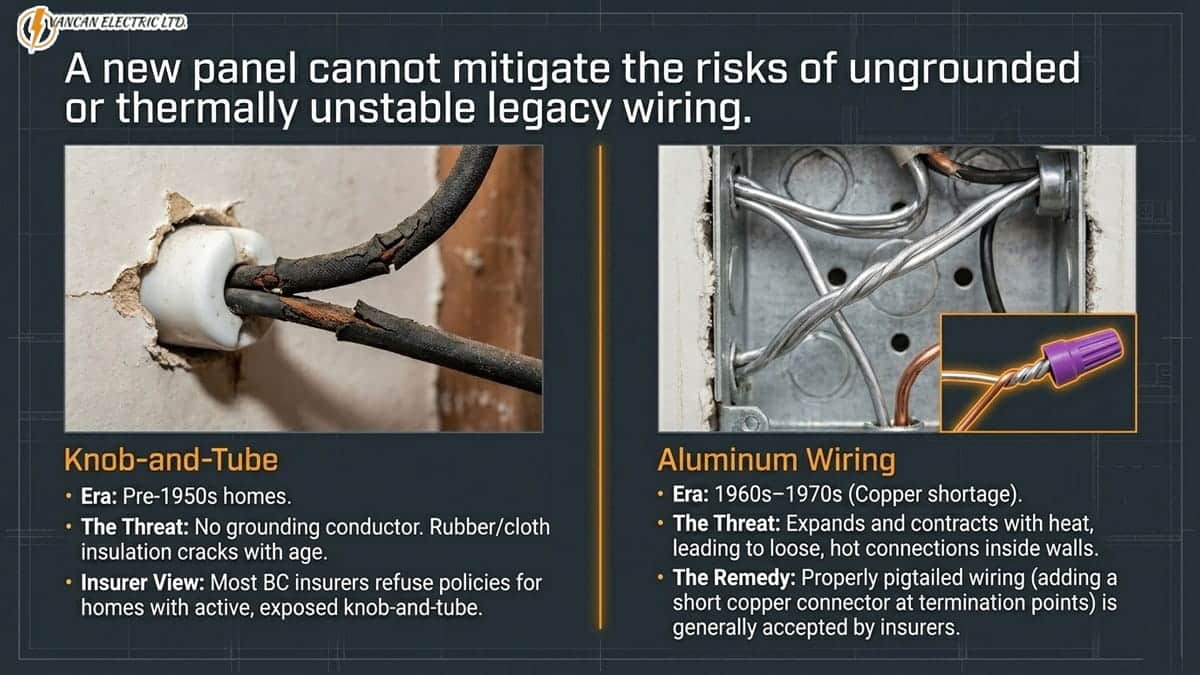
Knob-and-tube wiring shows up mostly in homes built before the 1950s. It routes conductors through ceramic knobs and tubes, with no grounding conductor at all. Its rubber or cloth insulation cracks with age. Most BC insurers will not write a policy on a home with exposed knob-and-tube still in service.
Aluminum wiring is a different concern. It became common in the 1960s and 1970s when copper prices spiked. The metal itself is not unsafe. But it expands and contracts more than copper, which loosens connections over time.
A loose aluminum connection runs hotter. A hot connection inside a wall is exactly the slow-building hazard insurers want fixed before it becomes a claim.
Properly pigtailed aluminum wiring, where a short copper connector is added at each termination point, is generally accepted. Unmodified aluminum at outlets and switches usually is not.
Undersized Service (60A vs Modern Demand)
Service size is its own line item on most insurance applications. A 60-amp service was standard decades ago, built for a furnace, a fridge, and maybe a window air conditioner. It was never designed for what a modern household draws.
Today’s homes commonly run:
- Central air conditioning or heat pumps
- Electric ranges and dryers
- Hot tubs or pool equipment
- EV chargers
A 60-amp panel has little headroom for any of that, let alone all of it at once. A growing number of insurers now flag sub-100-amp service on its own, even with no brand-related defects involved. This is the exact gap homeowners run into when they look into a panel upgrade for an EV charger and find their existing service cannot carry the extra load.
For homes still running on 60-amp or even older 100-amp service, the question often comes down to 200A vs 100A electrical service and which one actually supports where the house is heading.
What Happens When Your Insurer Flags Your Panel?
The notice usually arrives one of two ways: a request at renewal time, or a condition attached to a new policy before it is even issued.
Typical sequence once a panel gets flagged:
- Underwriter requests an electrical inspection report, often within 30 to 60 days
- A licensed electrician documents the panel’s brand, condition, and amperage
- The insurer reviews the report and decides on one of three outcomes
- If replacement is required, the insurer sets a deadline, commonly 30 to 90 days
- Once upgraded, the electrician issues a permit closure and the homeowner submits proof to the insurer
That third step is where most confusion comes from, because the three outcomes are not the same thing. A surcharge means you keep coverage but pay more. An exclusion means the panel itself is excluded from certain claims, while the rest of the policy stays intact. A denial means no policy at all until the panel is replaced.
Missing the deadline rarely ends well. Some insurers will cancel the policy outright. Others let it lapse at renewal without telling you until the new term is due, which leaves a gap exactly when you do not want one.
Cost of Upgrading vs. Cost of Staying Exposed
A standard panel upgrade in the BC market typically runs in the range below, depending on amperage and the complexity of the job.
| Scope of Work | Typical Cost Range (BC) |
|---|---|
| 100A panel replacement, like for like | $1,800 – $2,800 |
| Upgrade to 200A service | $2,800 – $4,500 |
| Federal Pioneer / Stab-Lok full replacement | $2,500 – $4,000 |
| Service upgrade requiring utility coordination | $3,500 – $6,000+ |
Staying exposed costs differently, and the bill does not show up all at once. A surcharge alone can add several hundred dollars a year to a premium, which compounds over the years you delay. A denied claim after an electrical fire is a different scale of loss entirely, since dwelling coverage, contents, and sometimes liability all ride on that single decision.
There is also a quieter cost. A flagged panel shows up in the disclosure documents during a home sale, and buyers’ agents know exactly what it means. Many sellers end up doing the upgrade anyway, just later and under more pressure.
Signs It’s Time to Call an Electrician Before Your Insurer Does
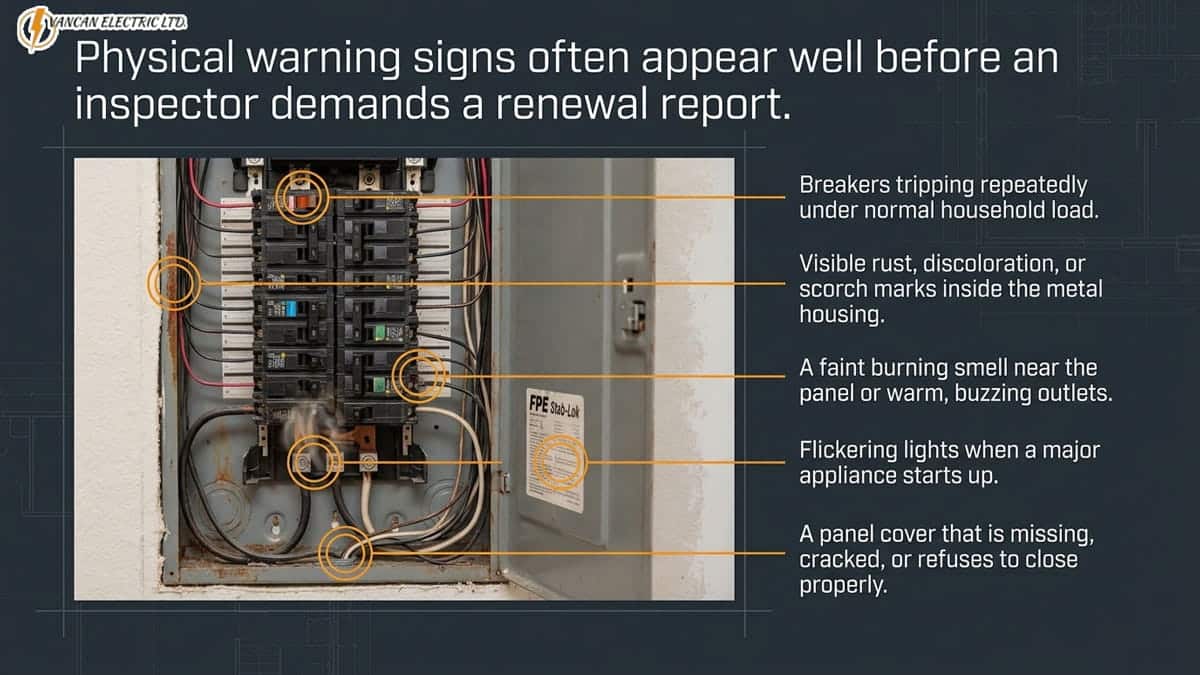
Some warning signs show up well before any inspection report does. Worth checking for:
- Breakers that trip repeatedly under normal household load
- A burning smell near the panel, even faint
- Visible rust, discoloration, or scorch marks inside the panel
- Warm or buzzing outlets and switches
- Flickering lights when a major appliance starts up
- A panel cover that is missing, cracked, or does not close properly
- Any FPE, Stab-Lok, or Zinsco label visible on the panel door
None of these guarantee an imminent failure. But each one is the kind of detail that shows up in an inspection report anyway, so catching it early on your own terms beats having it dictated by a renewal letter. If you are already noticing some of these signs, it is worth reading through the signs your home electrical system needs an inspection to see how many boxes your house checks.
How a Panel Upgrade Protects Both Your Home and Your Coverage?
A panel upgrade solves two problems with one job. It removes the physical fire risk sitting behind your drywall, and it removes the paper trail that keeps showing up every time your policy comes up for renewal.
The benefit compounds over time. A modern, code-compliant panel with proper amperage rarely gets flagged again, which means fewer surprises at renewal and more leverage if you ever shop around for a better rate. It also sets up anything you might want to add later, whether that is a heat pump, a hot tub, or an EV charger, without a second round of electrical work standing in the way.
If your home has not had its panel touched since before you bought it, this is usually the moment to find out where it actually stands. A licensed electrician can tell you in one visit whether you are looking at a routine upgrade or something your insurer is going to ask about regardless.
Conclusion
The connection between an old electrical panel home insurance risk and your actual coverage is not theoretical. It shows up on inspection reports, renewal letters, and sometimes claim denials, and it rarely improves on its own. If your panel is original to the house, undersized, or carries one of the flagged brand names, the smartest move is getting ahead of it before your insurer forces the timeline. Vancan Electric handles panel upgrades across BC and can tell you in one visit exactly where your home stands and what it would take to bring it up to code.