Outdoor EV Charger: 7 Proven Tips for a Safe, Weatherproof Setup in Langley
By Majid Akhbari, Red Seal Construction Electrician and Class B FSR | Vancan Electric, Langley, BC | Updated October 2026
Not every Langley home has a garage with room for a charger. Townhouses, older homes and shared driveways often leave one realistic choice: mount the charger on an exterior wall or a post and charge the car outside. The next question is almost always the same. Is that safe when it rains for weeks on end?
The short answer is yes, as long as the right equipment goes in the right way. An outdoor EV charger is designed to sit in rain, wind and the odd snowfall, and electric vehicles are built to be plugged in on wet days. Trouble usually starts with the wrong enclosure rating, a poor mounting spot, a household receptacle that was never meant for the weather, or a cable left lying in a puddle.
Below, our licensed electricians at Vancan Electric walk you through seven practical tips, the BC rules that actually matter, and the questions homeowners ask us most.
Is an Outdoor EV Charger Safe in Langley’s Rain?
Yes. EV charging in the rain is a normal part of owning an electric car in Canada, including in places with much harsher winters than ours. Canadian charger maker FLO says plainly that plugging in and unplugging in the rain is safe. That safety doesn’t come from luck. It comes from how the equipment is designed and how it’s installed.
How Your Charger Keeps EV Charging in the Rain Safe
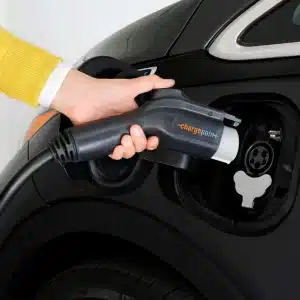
The connector on a Level 2 charger isn’t live while it hangs in its holster. Power only flows after the car and the charger complete a quick electronic “handshake” through a dedicated signal pin, and it stops before the pins separate when you unplug. That’s why EV charging in the rain doesn’t expose you to live metal.
Certified home chargers also have built-in ground-fault protection. If current starts leaking somewhere it shouldn’t, for example through water that got into a damaged cable, the charger shuts itself off in a fraction of a second. Add a sealed charge port on the car and a weather-rated enclosure on the wall, and you have several layers of protection working together.
Where the Real Risks Come From
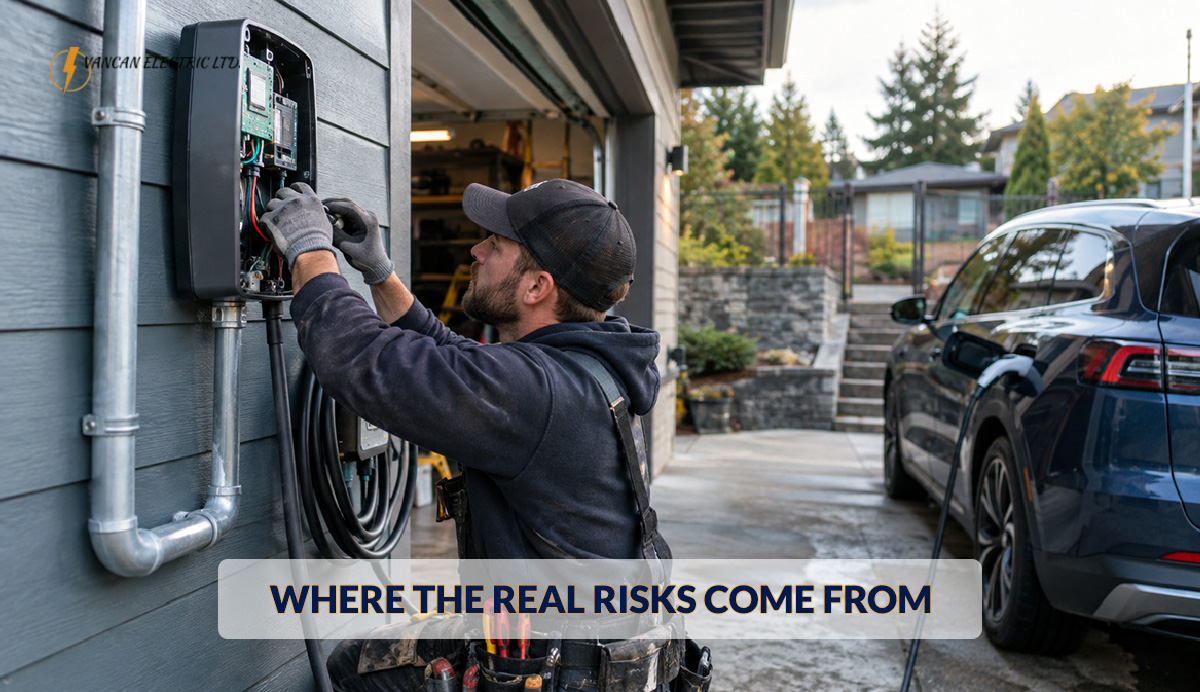
In practice, problems with outdoor charging rarely come from the rain itself. They come from shortcuts like these:
- An indoor-only charger mounted on an exposed wall because it was on sale
- A plug-in charger on a receptacle with a flat cover that can’t close while the plug is in
- Household extension cords, which should never be used for EV charging
- A connector left on the ground, where it fills with water and grit or gets driven over
- Chargers bought online without a recognized certification mark (in BC, electrical equipment must carry a mark or label from an accredited certification agency)
- Wiring done without a permit
Every one of these is avoidable, and the seven tips below are built around avoiding them.
7 Proven Tips for a Safe Outdoor EV Charger Setup
These tips follow the same order we use to plan a real job: the equipment first, then the location, the wiring, the power supply and finally day-to-day protection.
1. Choose a Weatherproof EV Charger With the Right Rating
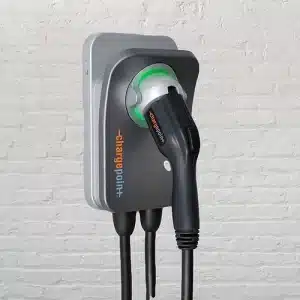
Every weatherproof EV charger lists an enclosure rating on its spec sheet, usually as a NEMA type, an IP code or both. That rating tells you exactly what the box can handle. Words like “rugged” or “all-weather” in the marketing copy don’t mean much on their own, so look for the number. In Langley, the bigger test for an outdoor EV charger is months of steady, wind-driven rain from fall to spring rather than deep cold, so water resistance deserves most of your attention.
NEMA and IP Ratings in Plain English
| Rating | What it protects against | Where it fits best |
|---|---|---|
| NEMA 3R | Rain, sleet and snow; not damaged by ice forming on the outside | Sheltered walls under an eave or carport roof |
| NEMA 4 | Everything in 3R, plus windblown dust, splashing and hose-directed water | Open walls that take wind-driven rain |
| NEMA 4X | Everything in NEMA 4, plus extra corrosion resistance | Fully exposed spots and homes closer to salt air |
| IP54 | Dust-protected; splashing water from any direction | Covered or partly sheltered locations |
| IP55 / IP65 | Dust-protected (5) or dust-tight (6); low-pressure water jets | Most exposed exterior walls and posts |
| IP66 | Dust-tight; powerful water jets | Very exposed or high-wind locations |
For a fully exposed driveway EV charger, NEMA 4 or 4X (or IP65 and up) is a sensible target. Under a deep overhang, NEMA 3R is often enough. Also check two more lines on any outdoor Level 2 charger spec sheet: the operating temperature range and the certification mark. If you’re still comparing models, our guide to EV charger brands that handle BC weather looks at weather tolerance brand by brand.
2. Pick the Right Spot Before You Pick the Charger
Location decides how easy an outdoor EV charger is to live with for the next ten years. Before mounting an EV charger outside, park the way you normally do and find the car’s charge port. Most home chargers come with a cable of about 18 to 25 feet, and it should reach the port without being pulled tight or crossing a walkway.
Then look closely at the wall itself. Keep the unit away from roof drip lines, downspouts and any spot where the gutter overflows in heavy rain. Avoid the corner where you pile snow when you shovel. If the charger is a smart model, check that your Wi-Fi reaches that spot, because scheduling and software updates depend on it. And never plan to run the cable under a garage door, since it gets pinched every time the door closes.
A Five-Minute Location Test
Park as you would on a busy weekday morning, with the second car in place if you have one. Run a tape measure from the proposed mounting point to the charge port along the path the cable would actually take, then add a few feet of slack. If the cable has to cross a sidewalk, a door swing or the path to your front door, move the spot. A shorter distance to the electrical panel helps too, because it means a shorter, simpler wiring run.
3. Hardwire the Charger When It Lives Outdoors
Many Level 2 chargers come in two versions: a plug-in model that uses a NEMA 14-50 receptacle, and a hardwired model connected directly to the circuit. Indoors, either one can work well. For an outdoor Level 2 charger, hardwiring is the more durable choice. FLO recommends it for outdoor installs, because a receptacle outside has to deal with moisture, temperature swings and plug wear every single day.
BC also has a specific rule worth knowing. Under Technical Safety BC’s rules for plug-in and hard-wired EV chargers in BC, a 14-50R or 6-50R receptacle used for a plug-in charger must be protected by a 50 A breaker. Any installation that calls for a 40 A breaker must be hard-wired, because no 40 A receptacle configuration exists. Higher-output chargers are a similar story: a 48 A model needs a 60 A circuit, which is why those units are normally hardwired from the start.
| Factor | Plug-in (NEMA 14-50) | Hardwired |
|---|---|---|
| Exposure to weather | Receptacle and plug face moisture and wear | Connections stay sealed inside the charger |
| Cover needed outdoors | Weatherproof cover that closes with the plug in | Nothing beyond the charger’s own enclosure |
| Highest charging setting | Up to 40 A on a 50 A breaker | Up to 48 A on a properly sized circuit |
| Moving later | Easy to unplug and take with you | An electrician disconnects it |
| Best fit | Sheltered spots and short-term setups | Exposed walls, driveways and posts |
If you do choose a plug-in model outside, the receptacle needs a weatherproof cover that stays closed with the cord plugged in. And no matter what the setup is, an extension cord is never part of it.
4. Use an EV Charger Pedestal When No Wall Is Close
Some parking spots simply aren’t near a wall: a detached parking pad, a long driveway, or a space beside a fence line. That’s where an EV charger pedestal comes in. It’s a sturdy post anchored to a concrete base, with power fed underground in conduit from the house or garage.
What a Pedestal Install Involves
- Planning the route and sizing the circuit, since longer runs can need heavier wire to limit voltage drop
- Requesting a free utility locate from BC One Call at least three full business days before any digging
- Trenching and laying conduit at the burial depth the BC Electrical Code requires
- Setting the base, mounting the post and pulling the new circuit
- Adding protection, such as a bollard, where vehicles turn or back up
- Permit paperwork, testing and final sign-off
| Feature | Wall-mounted | Pedestal |
|---|---|---|
| Best for | Parking spots within cable reach of the house | Detached pads, long driveways, spots away from walls |
| Wiring route | Through or along the exterior wall | Underground conduit in a trench |
| Extra work | Minimal | Utility locate, trenching, base and restoration |
| Vehicle protection | Mount it out of the car’s path | A bollard or wheel stop is often a good idea |
| Timeline | Usually the quicker option | Takes longer because of digging and restoration |
A driveway EV charger on a post keeps the cable short and the walls clear, which makes a real difference on a busy family driveway.
5. Check Your Panel and Circuit Before You Buy
An outdoor Level 2 charger is one of the biggest loads in a home, and it can run for hours at a time. In BC, plans and load calculations by a qualified person must be included with the permit application for EV charging equipment, so this step isn’t optional. An electrical load calculation in Langley shows whether your existing service can take the new circuit as it is.
If it can’t, there are usually two routes. One is a panel upgrade for an EV charger, which adds capacity for whatever comes next. The other is a load management device that pauses or slows charging when the house is busy, which avoids a full upgrade in many homes. Distance matters too: an EV charger pedestal at the far end of the driveway needs a longer run, and sometimes heavier wire, than an outdoor EV charger mounted beside the panel.
6. Keep the Cable and Connector Off the Ground
Most wear on an outdoor EV charger happens to the cable and connector, not the box on the wall. Hang the connector in its holster and coil the cable on a hook or cable organizer after every session. A connector left on the driveway fills with grit and water, and sooner or later someone drives over it.
Winter needs a little extra care. Brush snow off the holster before plugging in, and if the latch is iced over, give it a minute instead of forcing it or prying it with a tool. Never pressure-wash a weatherproof EV charger, even one with a high rating; a damp cloth is enough. For a full routine through the year, see our seasonal EV charger maintenance tips.
7. Protect It From Bumps, Tampering and Darkness
Technical Safety BC notes that the BC Electrical Code requires EV charging equipment to be installed and guarded against mechanical damage. Common ways to do that include mounting it out of the vehicle’s path, at a height a bumper won’t reach, behind a bollard, and back from curbs and parking stops. A driveway EV charger sits right where cars turn and back up, so this deserves real thought.
You also have to think about who else can reach an outdoor EV charger. Many smart models let you lock charging through an app, so neighbours and passers-by can’t plug in. Good lighting helps as well, both for finding the plug on a dark January evening and for security. Security motion sensor lights in Langley mounted over the parking area handle both jobs.
How a Licensed Electrician Installs an EV Charger Outside
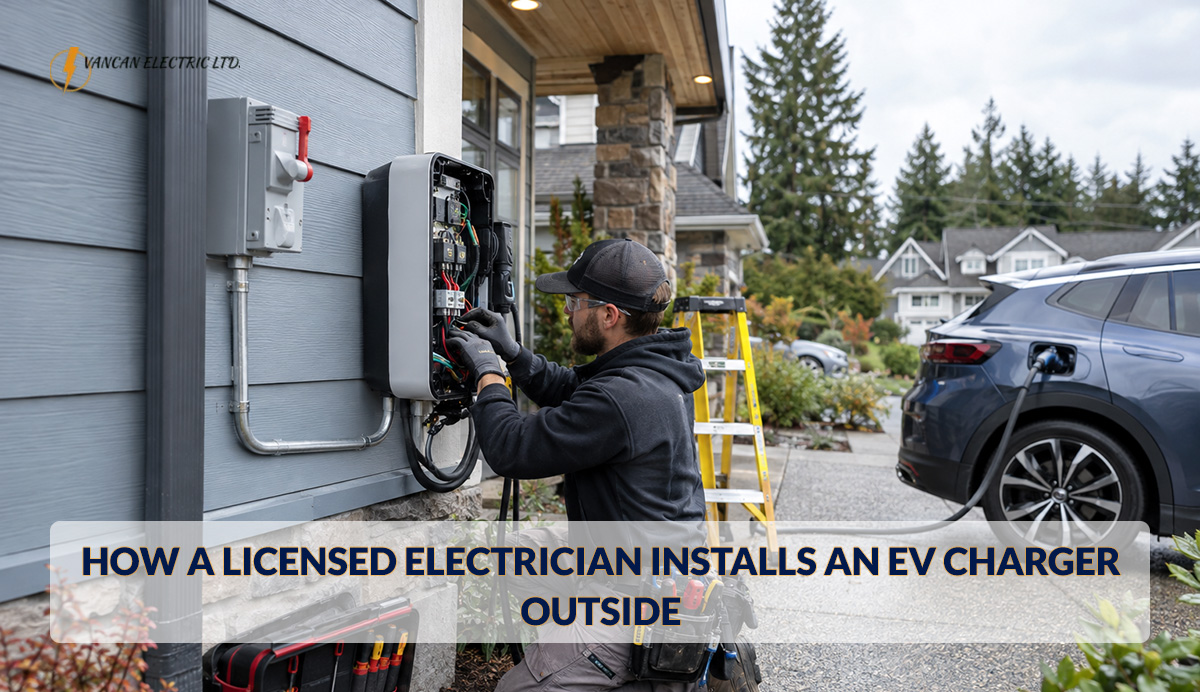
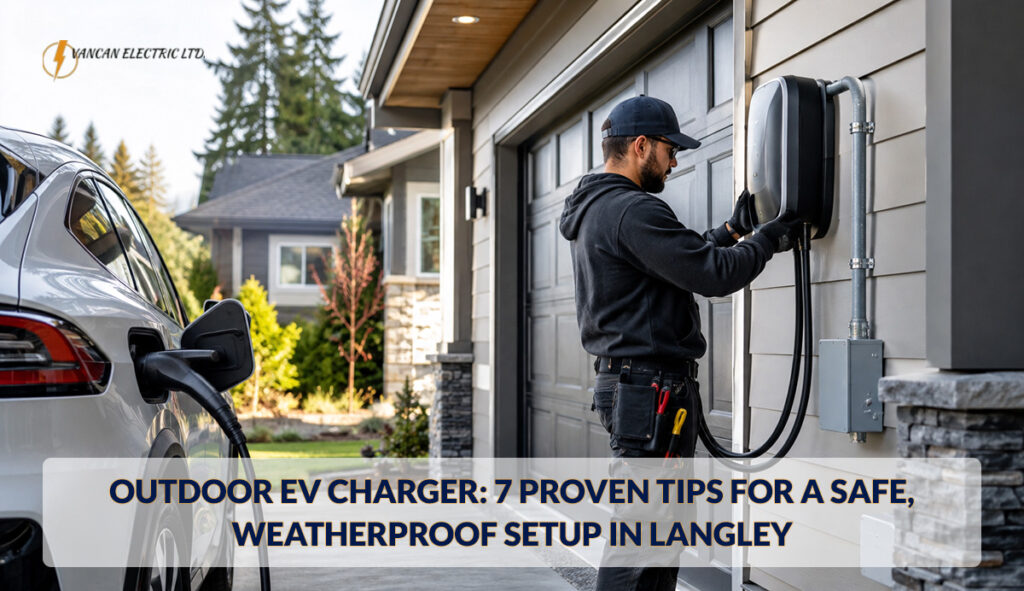
Here’s what a properly permitted outdoor EV charger installation looks like with our team, from the first call to the final sign-off.
First, we visit the home, look at the panel and the parking layout, and agree on the mounting spot with you. Next come the load calculation and the permit. Our guide to EV charger installation permits and rebates in BC explains that side in more detail. On installation day, we mount the charger or post, run and connect the circuit, and seal every opening in the wall so water can’t follow the wiring into the house. Before we leave, we test the charger with your vehicle and show you how to store the cable properly. Once everything checks out, the work is closed out under the permit.
What to Have Ready Before the Site Visit
A few details make the first visit faster and the quote more accurate. Take a clear photo of your electrical panel and its label, note where you usually park, and have the charger’s make and model handy if you’ve already bought one. If you live in a strata, check with the council early, because some installs need their approval before work can start.
Every job is done under our licence as an electrical contractor, and our permitted work is overseen by Majid Akhbari, a Red Seal Construction Electrician who holds a Class B Field Safety Representative certificate. To see everything we offer, visit our Level 2 EV charger installation in Langley page.
Conclusion
Charging outside works perfectly well in Langley’s climate, and EV charging in the rain quickly becomes part of the routine. The difference between a setup that lasts and one that causes trouble comes down to a handful of decisions: a weatherproof EV charger with the right enclosure rating, a well-chosen mounting spot, hardwiring where it makes sense, enough capacity in the panel, and simple habits like hanging the cable up after every charge. Get those right, and an outdoor EV charger will handle years of rain without any fuss.
If you’re planning a wall-mounted unit or a driveway EV charger at the far end of the lot, our team can look at your home and give you a straight answer on the best option. Read what local homeowners say about our licensed EV charger electricians in Langley on Google, or get in touch with our Langley electrical contractors to book a visit.
Frequently Asked Questions
Quick answers to the questions homeowners ask us most.
About the Author
Majid Akhbari is the owner and lead electrician at Vancan Electric in Langley, BC. He holds a Certificate of Qualification as a Red Seal Construction Electrician, recognized by SkilledTradesBC, and a Class B Field Safety Representative certificate recognized by Technical Safety BC. His team installs EV chargers for homes and businesses in Langley, Surrey, Vancouver, Abbotsford and nearby cities.
Sources
- Technical Safety BC, Information Bulletin IB-EL 2023-05 (Revision 3): Electric Vehicle Supply Equipment (EVSE) and Electric Vehicle Energy Management Systems (EVEMS), March 4, 2025
- Technical Safety BC, Approved Certification Marks for Electrical Products
- Technical Safety BC, The 1 Thing You Must Do Before You Excavate (BC One Call)
- NEMA, NEMA Enclosure Types (summary of NEMA Standards Publication 250)
- IEC 60529, Degrees of Protection Provided by Enclosures (IP Code)
- FLO, Installing Your EV Charger Outside: Read This First, November 12, 2024