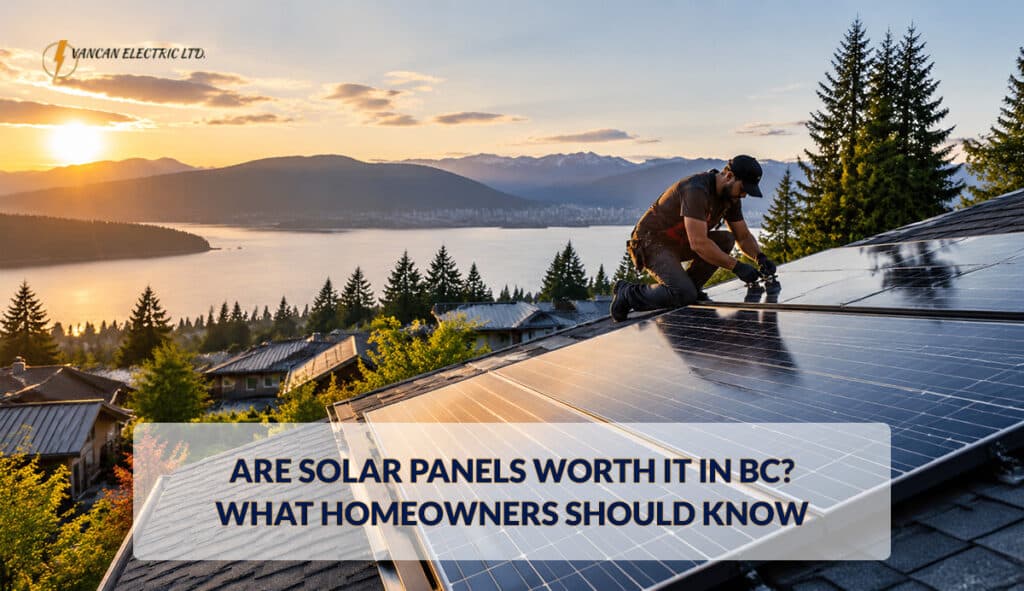

Are Solar Panels Worth It in BC? What Homeowners Should Know
Introduction
Solar has never been a simple yes or no in British Columbia, and recent BC Hydro changes made the question harder. In June 2026, the utility began requiring rebate-eligible systems to be installed by a member of its Home Performance Contractor Network. In July 2026, net metering closed to new customers and a new export rate replaced it. So when a homeowner in Langley or Surrey asks us, “Are solar panels worth it in BC right now?”, our honest answer is that it depends on a handful of things you can check before you spend a dollar.
This guide walks through the seven factors that decide it: the new export rate, installed costs, rebates, our rainy climate, your roof, your electrical panel and how much of your own power you use. We write from the electrical side of the job, because that is the part many solar quotes skip. By the end, you will know whether solar fits your home and your plans.
So, Are Solar Panels Worth It in BC? The Short Answer
For many Lower Mainland homes, yes, but only when the system is sized around the power you use on site. The grid used to act like a free battery. Now every kilowatt-hour you export earns a fixed 10 cents, while every kilowatt-hour you avoid buying saves your full retail rate. That gap rewards homes with an EV, a heat pump or someone home during the day, and it penalizes oversized systems built to export.
Are solar panels worth it in BC for every home, then? No. If your roof faces south or west with little shade, your panel can accept a solar connection and you plan to stay ten years or more, the numbers usually hold up. If your roof needs replacing soon or your lot sits under tall cedars, the case weakens quickly.
Factor 1: The BC Hydro Self-Generation Rate Changed the Math
Until July 1, 2026, most solar owners were on net metering, formally Rate Schedule 1289, which banked surplus power as full-value kWh credits. That schedule is now closed to new customers. Every new connection goes onto the BC Hydro self-generation rate, Rate Schedule 2289, and homeowners who accepted a rebate were moved onto it as well.
If you have searched for BC Hydro net metering 2026 news, this is the change many articles still miss. It is the first reason any quote prepared before July deserves a second look, and why older answers to “are solar panels worth it in BC” no longer hold.
How Net Billing Shows Up on Your Bill
Under the BC Hydro self-generation rate, surplus power is handled through net billing. If your panels produce more than your home uses over a billing cycle, the extra becomes a dollar credit at a fixed 10 cents per kWh. BC Hydro’s own example: 50 surplus kWh becomes a $5 credit. The credit covers energy charges only, so your basic daily charge stays. The 10 cent price is also expected to be reviewed after five years.
What If You Already Have Solar?
If you were on net metering before July 1 and never took a rebate, you keep Rate Schedule 1289 for up to 10 years from your original start date, then move to the new rate automatically. The BC Hydro net metering 2026 cut-off does not change your existing credits, but once an account moves to the new schedule, it cannot switch back.
| Feature | Net metering (RS 1289) | Self-generation rate (RS 2289) |
|---|---|---|
| Who it applies to | Existing customers only, for up to 10 years | New connections since July 1, 2026, plus rebate recipients |
| How surplus is credited | Banked as kWh credits | Converted to a dollar credit each billing cycle |
| Value of exported power | Matched the rate you paid for power | Fixed at 10 cents per kWh |
| What it rewards | Exporting in summer, drawing credits in winter | Using your own solar power on site |
Factor 2: The Real Solar Panel Cost BC Homeowners Pay
BC Hydro’s published averages put the total installed solar panel cost BC homeowners pay at $2,000 to $3,000 per kilowatt of DC capacity, labour and materials included, with about $2,500 per kW as a typical midpoint. Solar equipment bought as part of a PV system can also qualify for a PST exemption, so check that your quote reflects it.
| System size | Installed cost before rebates | Estimated yearly production |
|---|---|---|
| 5 kW | $10,000 to $15,000 | 5,000 to 6,000 kWh |
| 8 kW | $16,000 to $24,000 | 8,000 to 9,600 kWh |
| 10 kW | $20,000 to $30,000 | 10,000 to 12,000 kWh |
Figures are scaled from BC Hydro’s averages. Roof direction, tilt and shade will move them.
What Pushes the Price Up
The solar panel cost BC homeowners end up paying rises when the roof needs repairs first, access is difficult, premium panels are chosen or the electrical system needs work before it can accept a second power source. An electrical panel upgrade for solar can add several thousand dollars, so it belongs in the quote from day one.
Factor 3: BC Hydro Solar Rebate and Battery Rebate Rules
Rebates cut the upfront price, but only when every step happens in the right order. They are offered first come, first served while funding lasts, so read BC Hydro’s official page on BC Hydro rebates for solar panels and battery storage before you sign anything.
How Much the Rebates Pay
There are two incentives, one for panels and one for a paired battery, and together they lower the net solar panel cost BC homeowners carry.
Solar Panel Rebate
The BC Hydro solar rebate pays $1,000 per kW of installed DC capacity, capped at 50% of your total installed cost and at $5,000 for an individually metered home. Most systems of 5 kW or more reach that ceiling.
Battery Storage Rebate
The solar battery rebate BC Hydro offers pays $500 per kWh of storage capacity, capped at 50% of cost. The home maximum is $1,500, or $5,000 if the battery is enrolled in the Peak Saver program. Battery-only systems qualify only with Peak Saver enrolment.
| Incentive | Rebate rate | Residential maximum |
|---|---|---|
| BC Hydro solar rebate | $1,000 per kW DC | $5,000, and no more than 50% of cost |
| Solar battery rebate BC, paired with solar | $500 per kWh | $1,500 |
| Battery enrolled in Peak Saver | $500 per kWh | $5,000 |
Rules That Cost Homeowners Their Rebate

Most lost rebates come down to timing and paperwork. Check these points first:
- Get pre-approval first. Submit a self-generation application and wait for technical acceptance before you buy equipment.
- Hire an HPCN contractor. Since June 1, 2026, systems must be designed and installed by a Home Performance Contractor Network member. Self-installs do not qualify.
- Check the equipment. Tesla products are not eligible, and equipment must be new, purchased in Canada and CSA certified.
- Confirm your property type. Detached homes, duplexes, row homes, townhomes and mobile homes on permanent foundations qualify. FortisBC customers do not.
- Keep the invoice clean. Payment follows within 60 days of interconnection approval, based on an itemized, paid invoice.
Factor 4: Lower Mainland Weather and Real Production
Rain is the first objection we hear from Fraser Valley homeowners. Grey winters cut output, but annual production drives savings. BC Hydro estimates that a typical 10 kW rooftop system in the province generates about 10,000 to 12,000 kWh a year, while the average household uses about 10,000 kWh. That is why “are solar panels worth it in BC” can still get a yes on the wet coast.
Do Solar Panels Work in Vancouver Weather?
Yes. Panels respond to daylight rather than heat and keep producing on overcast days at a lower level. Cool temperatures even help efficiency. So when someone asks us, “Do solar panels work in Vancouver weather?”, the honest answer is that they work well from April through September and modestly in the darkest months.
Summer Surplus, Winter Shortfall
Summer surplus now earns 10 cents, while winter shortfalls are bought back at full retail. A system sized around summer daytime use, not your whole annual bill, usually earns more per dollar.
Factor 5: Your Roof, Shade and Space
Each kilowatt of panels needs about seven to eight square metres of south-facing free space, so a 6 kW system needs roughly 45 square metres. South is ideal, though west and east faces can work. Heavy shade from cedars or neighbouring buildings is the fastest way to ruin the numbers.
Roof age matters too. Panels last around 25 years, and removing them for a new roof adds cost, so replace a tired roof first. A careful solar panel installer Surrey homeowners hire should raise this before quoting. Strata homes also need written strata council approval.
Factor 6: Your Home’s Electrical Capacity
This is the factor we see overlooked most. You cannot answer “are solar panels worth it in BC” for a specific home without looking inside its electrical panel. Solar adds a second power source to that panel, yet many quotes assume it is fine without opening the cover, which is how an electrical panel upgrade for solar becomes a late surprise.
Panel and Busbar Capacity
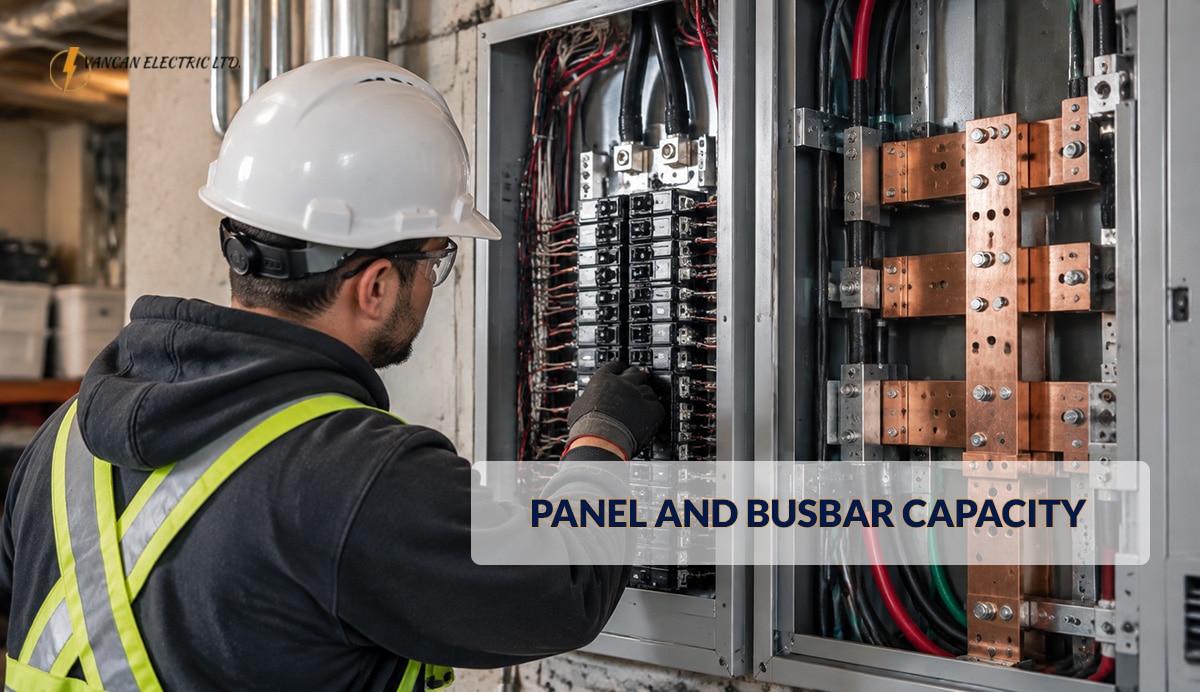
Every panel has a busbar rating, and electrical code rules limit how much combined current from the utility and the solar inverter that busbar can carry. Older 100A panels, full panels and obsolete brands are where problems usually appear. A licensed electrician should check the rating, breaker layout and panel condition before the design is final, so ask any solar panel installer Surrey or Langley homeowners consider who will open it.
When a Panel Upgrade Makes Sense
An electrical panel upgrade for solar is worth considering when the busbar cannot take the inverter’s output, the panel is full or you are also planning an EV charger or heat pump. One permit for everything is usually cheaper than two. Our guide to electrical load calculation for Langley homes explains how capacity is assessed before any upgrade is quoted.
Permits, Inspection and Interconnection
Grid-tied solar needs a permit, a final inspection and BC Hydro’s approval to connect. Every solar installation Langley homeowners book should follow the same order: application, technical acceptance, installation, inspection, then interconnection approval. An unpermitted system will not clear BC Hydro’s process.
Factor 7: How Much of Your Solar Power You Use at Home
Self-consumption is now the biggest lever. Each kWh your home uses as it is produced saves your full retail price, roughly 12 to 14 cents depending on your rate and usage, while each exported kWh earns 10 cents. Over 25 years, that gap decides whether a system pays back in the low teens or drifts toward twenty years. If you are asking, “Is solar worth it in BC for my household?”, start with your own bill.
A Worked Solar Payback Period BC Example
Here is a simplified example for an 8 kW system on a Fraser Valley home. Swap in numbers from your own bill.
| Item | Assumption | Result |
|---|---|---|
| System cost | 8 kW at $2,500 per kW | $20,000 |
| BC Hydro solar rebate | $1,000 per kW, capped at $5,000 | Minus $5,000 |
| Net cost | Cost minus rebate | $15,000 |
| Yearly production | About 1,100 kWh per kW | 8,800 kWh |
| Used on site (65%) | 5,720 kWh at 13 cents | About $744 |
| Exported (35%) | 3,080 kWh at 10 cents | About $308 |
| First-year savings | Both combined | About $1,052 |
| Simple payback | Net cost divided by savings | About 14 years |
In this example, the solar payback period BC homeowners could expect is about 14 years. Raise self-consumption to 80% on the higher rate step and it falls to about 13 years. Industry estimates for the new rate generally land between 11 and 14 years. Budget for a possible inverter replacement too, because an honest solar payback period BC estimate includes it.
Who Tends to Come Out Ahead
Homes that use plenty of daytime power benefit most:
- Households with an EV that can charge at home during the day
- Homes heated and cooled with a heat pump
- Families, retirees or remote workers who are home in the daytime
- Owners planning to stay in the home for 10 years or longer
If an EV is on your list, our guide on how much power an EV charger uses at home will help you estimate how much solar output it could absorb. For EV owners, “is solar worth it in BC” usually gets a firmer yes than for most households.
Solar, Batteries and Power Outages
A common surprise: a standard grid-tied system shuts off during an outage, even at noon in July, to protect line crews. If backup matters, you need a battery set up for backup or a generator. For some families, backup is what finally answers “is solar worth it in BC“. If you are caught without it, our guide on what to do during a power outage covers the basics.
A battery keeps essentials running quietly and can qualify for the solar battery rebate BC Hydro offers. A standby generator handles longer outages, and our standby generator installation in Langley service explains that option.
How to Compare Solar Quotes and Avoid Pressure Sales

Since August 1, 2026, new consumer protection rules limit high-pressure door-to-door solar sales in BC, and BC Hydro warns homeowners about “free solar” offers. Get three quotes on the same assumptions.
Ask each company whether it is an HPCN contractor, how much production it expects you to use on site and whether exports were valued at the BC Hydro self-generation rate of 10 cents rather than your retail rate. Quotes written before the BC Hydro net metering 2026 change often use the old credit value, which makes payback look shorter than it is. Ask who pulls the permit and whether anyone inspected your panel. Whether you hire a solar panel installer Surrey homeowners recommend or a regional firm, a good quote answers “are solar panels worth it in BC” with your numbers, not averages.
Planning Solar in Langley, Surrey or the Fraser Valley?
Where you live also changes how “are solar panels worth it in BC” plays out. Langley and Aldergrove properties often have acreage and outbuildings, so a solar installation Langley owners plan may use a ground mount or a detached garage roof, which can qualify if it connects to the main account. Surrey and Vancouver homes more often deal with tighter lots, shading and strata rules, which a good solar panel installer Surrey homeowners trust will plan around.
Wherever you live, the order is the same: roof, panel, pre-approval, then installation. When comparing options for a solar installation Langley families will rely on for 25 years, look past the panel brand to the electrical work behind it, and confirm in writing that the installer is an HPCN contractor.
Vancan Electric works as a licensed electrician in Langley BC, and we can assess your panel and load before you commit to a solar installation Langley inspectors will approve the first time.
When you are ready, get a free electrical quote in Langley and talk it through with us.
Conclusion
Since the BC Hydro net metering 2026 change, solar here is no longer about the grid banking every kilowatt-hour for you. It is about fit. For homes with good sun, a panel that can take the load and a household that uses much of its own power, the answer to “are solar panels worth it in BC” is still yes, with payback in the low to mid teens and decades of production after that. For shaded lots, ageing roofs or low usage, a smarter first step may be an energy conservation consultation for your home to see where your power goes.
So, are solar panels worth it in BC for you? Run the seven factors, value exports at 10 cents, confirm your rebate path and get the electrical side checked early. Then decide on real numbers, not a sales pitch.
Frequently Asked Questions
Quick answers to the questions homeowners ask us most.