

Solar Installation Cost in BC: Prices, Rebates and Payback
By Majid Akhbari, Red Seal Construction Electrician and Class B FSR | Vancan Electric, Langley, BC | Updated November 2026
If you are wondering how much do solar panels cost in BC, the short answer is that most Lower Mainland homes pay somewhere between $13,000 and $30,000 before rebates, depending on the size of the system. That range is wide because no two roofs, panels, or households are the same. A small 5 kW system on a simple south-facing roof costs far less than a 10 kW system on a steep, shaded roof that also needs a panel upgrade. This guide breaks down the real numbers.
The solar installation cost for your home depends on system size, roof condition, equipment, and the electrical work behind the meter. Rebates and the new BC Hydro export rate change the math again. Below, our licensed electricians explain what a system costs by size, what drives the price up or down, what a proper quote should include, which rebates you can still claim in 2026, and how long payback really takes.
Most quotes look similar, but the details underneath can differ by thousands of dollars. One installer may include the permit, the BC Hydro application, and a new inverter in the price, while another leaves them out and adds them later. The solar installation cost that matters is the total you pay before the rebate, not the headline number on the first page. This guide shows you how to compare quotes on equal terms.
Below, we cover the cost of a system by size, the seven factors that move the price, what a complete quote should show, the hidden costs that surprise BC homeowners, the rebates still available in 2026, and a worked payback example for a 6 kW system. The solar installation cost in BC has changed since net metering ended in July 2026, so a quote written before that date deserves a second look.
How Much Do Solar Panels Cost in BC?
So how much do solar panels cost in BC once everything is included? Start with the per-watt price. In 2026, installed solar in BC typically runs $2.60 to $3.27 per watt, according to Green Building Canada’s 2026 pricing guide, with Lower Mainland jobs at $3.10 to $3.65 per watt. The solar installation cost for a home is the system size in watts times that rate, plus any electrical or roof work your home needs.
BC Hydro’s published averages say the same. The solar panel installation cost BC homeowners pay runs $2,000 to $3,000 per kW of DC capacity, labour and materials included, with about $2,500 per kW as a typical midpoint. On that basis, the table below shows what each system size costs before rebates.
| System size | Installed cost before rebates | Estimated yearly production |
|---|---|---|
| 5 kW | $10,000 – $15,000 | 5,000 – 6,000 kWh |
| 6 kW | $12,000 – $18,000 | 6,000 – 7,200 kWh |
| 8 kW | $16,000 – $24,000 | 8,000 – 9,600 kWh |
| 10 kW | $20,000 – $30,000 | 10,000 – 12,000 kWh |
These figures are scaled from BC Hydro’s $2,000 to $3,000 per kW averages, with production of about 1,000 to 1,200 kWh per kW each year. Roof direction, tilt, and shade will move them, and Lower Mainland quotes sit at the top of the table.
What a Typical System Costs by Size
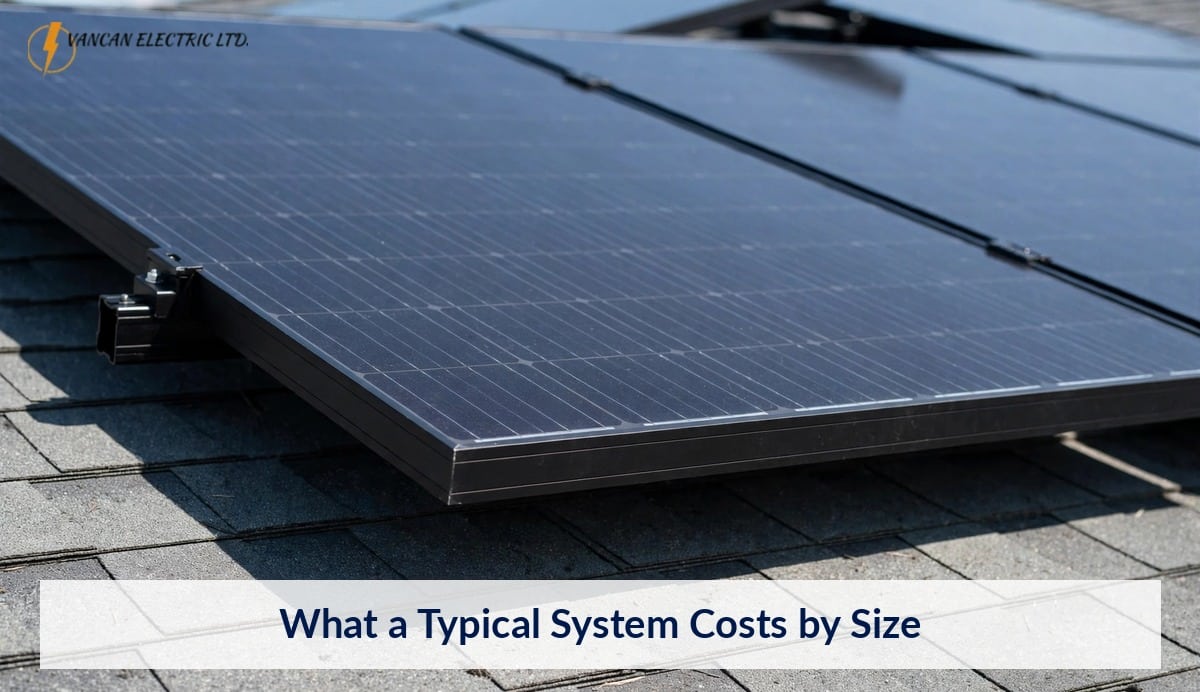
Most Lower Mainland homes need a 6 kW to 8 kW system, roughly 15 to 20 panels. The solar panel installation cost for a 6 kW system at Lower Mainland rates runs about $18,600 to $21,900, and an 8 kW system about $24,800 to $29,200. Smaller homes with gas heat and no EV can manage with 5 kW; a home with an EV, a heat pump, and electric heat may need 10 kW.
What Drives the Price? 7 Cost Factors
Two homes on the same street can receive quotes thousands of dollars apart, and both can be fair. The solar installation cost for your home is set by a handful of factors, and knowing them helps you judge whether a quote is reasonable or padded.
1. System Size
Size is the biggest driver. A larger system costs more in total, but the price per watt usually falls as it grows, because design, permits, and travel are spread over more panels. So a 10 kW system costs less per watt than a 5 kW one, though the total is higher.
2. Roof Condition and Shape
A simple, south-facing roof with easy access is cheapest to work on. A steep pitch, a complex roof, or a roof that needs repairs first all add labour and time. If the roof is near the end of its life, replace it first, because removing and reinstalling panels later costs extra.
3. Panel and Inverter Choice
Premium panels with higher efficiency cost more per watt, and the inverter choice matters. A single string inverter is cheapest, while microinverters under each panel cost more upfront but handle shade better and carry longer warranties. The right choice depends on your roof.
4. Your Electrical Panel
The solar panel installation cost BC homeowners end up paying rises when the panel needs work first. A licensed electrician should check the busbar rating and breaker layout before the design is final.
5. Permits and BC Hydro Paperwork
Every grid-tied system needs a municipal permit, a final inspection, and BC Hydro’s approval to connect. In Vancouver, permit fees run about $300 to $600 for a home. A quote that skips the paperwork is not a bargain, it is unfinished.
6. Access and Labour
Labour is a large share of the price in BC. A two-storey home that needs scaffolding, a roof with poor access, or a site far from the installer’s base all cost more. Lower Mainland labour rates are among Canada’s highest.
7. Battery Storage
A battery adds several thousand dollars to the job. It lets you use more of your own power at night and keeps essentials running in an outage. Whether it is worth it depends on how much you value backup power.
Solar Panel Installation Cost: What Your Quote Should Include
A complete quote should read like an itemised list. The solar panel installation cost in a proper quote covers the panels, the inverter, racking, wiring, the permit, the BC Hydro application, and the inspection. The solar installation cost you compare should always be the same list, so ask for the breakdown in writing.
- Panels and racking, with make, model, and wattage listed.
- The inverter, string or microinverter, with its warranty in years.
- Electrical work, including the panel, wiring, and disconnects.
- Permits and the BC Hydro self-generation application.
- Labour, scaffolding, and cleanup, with no surprise fees.
- Monitoring, so you can see production.
If any line is missing, ask where it is. A quote that leaves out the permit or the inverter is not cheaper, it is incomplete. Our guide to whether solar panels are worth it in BC covers whether solar fits your home.
Hidden Costs That Surprise BC Homeowners
The quote is only part of the story. The solar installation cost most homeowners budget for leaves out the work around the panels. None of them means solar is a bad idea, but each belongs in your budget before you sign, not after the panels are on the roof.
A Panel Upgrade
Solar adds a second power source to your panel, and many older 100-amp panels cannot take it. A panel swap typically runs $2,500 to $5,000, and a full service upgrade adds $1,500 to $4,000, with permits and inspection at $150 to $400. Read our guide to electrical panel upgrade in Langley and Surrey before you assume your panel is ready.
Roof Repairs First
Panels last about 25 years, so replace a roof with five years left first. Removing and reinstalling panels for a new roof costs extra, and most installers will not warrant a system on a roof they flagged as tired. A roofer’s opinion first is money well spent.
Inverter Replacement
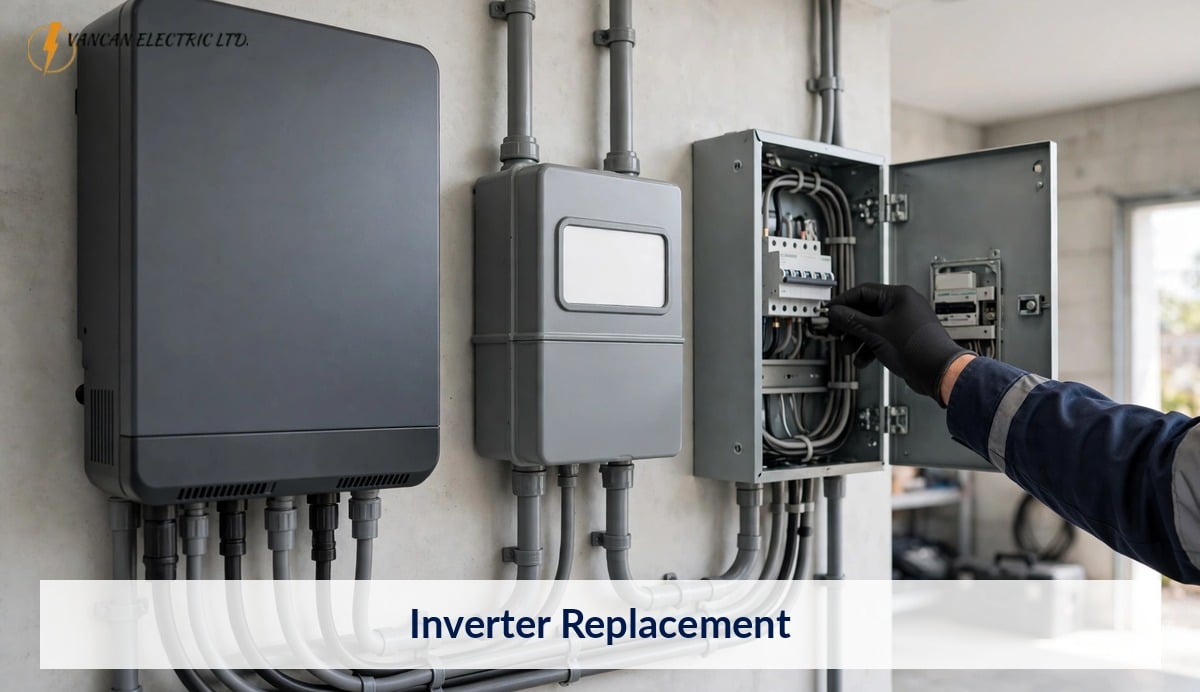
A string inverter typically lasts 10 to 15 years, so budget for one replacement. Installed replacement runs $1,500 to $3,000 for a typical 5 to 8 kW home system, according to 2026 installer guides. Microinverters last 20 to 25 years, and one unit costs $150 to $250 plus labour, but each swap means roof access.
Solar Rebates BC: What You Can Claim in 2026
Rebates cut the upfront price, but only when every step happens in order. The solar installation cost you actually pay is the quoted price minus the rebates you qualify for. Solar rebates BC homeowners can claim in 2026 come almost entirely from BC Hydro, because the federal programs are closed.
BC Hydro Solar Rebate
BC Hydro pays $1,000 per kW of installed DC capacity, capped at 50% of installed cost and at $5,000 for a home. Most systems of 5 kW or more reach that ceiling. The rebate is first come, first served while funding lasts, and paid within 60 days of interconnection approval. See the BC Hydro solar and battery rebates for the current terms before you sign anything.
| Incentive | Rebate rate | Residential maximum |
|---|---|---|
| BC Hydro solar rebate | $1,000 per kW DC | $5,000, and no more than 50% of cost |
| Solar battery rebate, paired with solar | $500 per kWh | $1,500 |
| Battery enrolled in Peak Saver | $500 per kWh | $5,000 |

Battery Rebate
A battery paired with solar earns $500 per kWh of storage, up to $1,500, or up to $5,000 with Peak Saver enrolment. Battery-only systems qualify only with Peak Saver enrolment. Solar rebates BC homeowners claim for batteries are paid on the same 60-day schedule. That lowers the net solar panel installation cost BC homeowners carry when they add storage, and the combined solar and battery rebate for a home can reach $10,000.
Rules That Cost Homeowners Their Rebate
Most lost rebates come down to timing and paperwork. Get pre-approval first, and wait for technical acceptance before you buy equipment. Since June 1, 2026, the system must be designed and installed by a Home Performance Contractor Network member, and self-installs do not qualify. Tesla products are not eligible, equipment must be new, Canadian-bought, and CSA certified, and FortisBC customers do not qualify.
No Federal Solar Rebate in 2026
Do not budget for federal help. The Canada Greener Homes Grant closed to new applicants in February 2024, and the Greener Homes Loan closed to new applications on October 1, 2025. The Canada Greener Homes Affordability Program covers insulation and heat pumps, but not solar. In BC, the rebate picture in 2026 is BC Hydro alone.
Payback: How Long Until Solar Pays for Itself?
Payback is the question every homeowner asks, and the honest answer is about 11 to 14 years for most BC homes under the new rules. The solar installation cost is only half the equation; the other half is how much of your own power you use. Every kilowatt-hour you use as it is produced saves your full retail rate, while every exported kilowatt-hour earns a flat 10 cents under BC Hydro’s self-generation rate.
| Item | Assumption | Result |
|---|---|---|
| System cost | 6 kW at $2,500 per kW | $15,000 |
| BC Hydro solar rebate | $1,000 per kW, capped at $5,000 | Minus $5,000 |
| Net cost | Cost minus rebate | $10,000 |
| Yearly production | About 1,100 kWh per kW | 6,600 kWh |
| Used on site (65%) | 4,290 kWh at 13 cents | About $558 |
| Exported (35%) | 2,310 kWh at 10 cents | About $231 |
| First-year savings | Both combined | About $789 |
| Simple payback | Net cost divided by savings | About 13 years |
In this example, the solar installation cost after the rebate is $10,000, and the system saves about $789 in its first year, a payback of about 13 years. Raise self-consumption to 80% and payback falls toward 12 years; size the system to export most of its power and it stretches past 15. Budget for one inverter replacement too.
How to Compare Solar Quotes and Avoid Pressure Sales
Since August 1, 2026, new rules limit high-pressure door-to-door solar sales in BC, and BC Hydro warns about “free solar” offers. The solar installation cost on the cheapest quote is not always the cheapest system, so get three quotes on the same assumptions.
- Same system size in kW, so the per-watt price compares.
- Same equipment: panel make and model, inverter type, and warranty.
- Same scope: permit, BC Hydro application, inspection, and monitoring included.
- Production estimate in kWh per year, and its self-consumption assumption.
- Whether exports were valued at the 10-cent self-generation rate, not your retail rate.
- Who pulls the permit, and whether anyone inspected your panel.
Ask each company whether it is an HPCN contractor, how much production it expects you to use on site, and what happens if the roof needs work. A good quote answers with your numbers, not averages. If a salesperson will not put the breakdown in writing, that is your answer.
Your Electrical Panel: The Step Solar Quotes Skip
This is the step we see skipped most often. The solar installation cost in a quote often assumes your panel can accept a second power source without anyone opening the cover. Every panel has a busbar rating, and code rules limit how much combined current from the utility and the inverter that busbar can carry. Older 100-amp panels, full panels, and obsolete brands are where problems appear.
A licensed electrician should check the rating, breaker layout, and panel condition before the design is final. Our guide to electrical load calculation for Langley homes explains how capacity is assessed before any upgrade is quoted. Vancan Electric handles the electrical side of solar in partnership with Infinity Solar Group.
The same panel questions come up for an EV charger, so many homeowners plan solar and a charger together. Read our guide on panel upgrade for an EV charger to see when a panel upgrade is needed for a charger.
Conclusion
Solar installation cost in BC in 2026 is a range, not a single number. A 5 kW system runs $10,000 to $15,000 before rebates, an 8 kW system $16,000 to $24,000, and the BC Hydro rebate takes up to $5,000 off the top. Your price moves with your roof, your panel, your equipment, and how much of your own power you use at home.
Get three quotes on the same assumptions, check the HPCN and rebate rules before you sign, and have a licensed electrician check your panel first. The solar installation cost that matters is the total you pay, the rebate you actually receive, and the years it takes to earn it back. If you are in Langley, Surrey, Vancouver, or Abbotsford, call us at (778) 987-0859 for a free quote, or read what local homeowners say about our licensed electricians in Langley on Google.
Frequently Asked Questions
Quick answers to the questions BC homeowners ask us most.
About the Author
Majid Akhbari is the owner and lead electrician at Vancan Electric in Langley, BC. He holds a Certificate of Qualification as a Red Seal Construction Electrician, recognized by SkilledTradesBC, and a Class B Field Safety Representative certificate from Technical Safety BC. His team helps homeowners across Langley, Surrey, Vancouver, Abbotsford and nearby cities with solar-ready electrical work.
Sources
- BC Hydro, Rebates for solar panels and battery storage
- Green Building Canada, Here’s What Solar Panels Cost in Canada in 2026
- SolarCalculatorHQ, Solar Panel Cost by Province (2026 Canadian Pricing Guide)
- EnergyScout, Solar Inverter Lifespan: When to Replace It
- SolarCalculatorCanada, Solar Power Cost in Canada
- BC Electrical Code (Canadian Electrical Code, Part I, CSA C22.1, as adopted in British Columbia).